
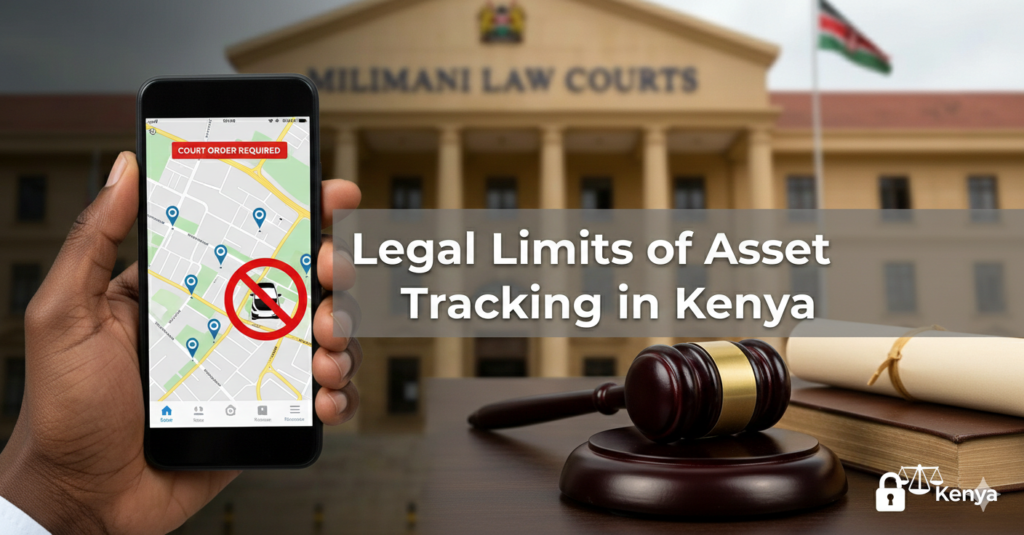
Asset tracking is a powerful tool for recovering vehicles used as loan collateral. However, in Kenya, how an asset is tracked matters as much as whether it is located.
Banks, microfinance institutions, SACCOs, and investigators who overstep legal boundaries expose themselves to:
- Court challenges
- Regulatory scrutiny
- Claims of unlawful surveillance
- Reputational damage
This article explains the legal limits of asset tracking in Kenya, what is permissible, what is risky, and how lenders can pursue recovery without violating the law.
Why Legal Compliance Matters in Asset Tracking
Kenyan courts place significant weight on:
- The right to privacy
- Lawful acquisition of evidence
- Procedural fairness
Evidence obtained unlawfully may:
- Be challenged or excluded
- Undermine recovery proceedings
- Expose lenders to counterclaims
Professional asset tracking must therefore balance effectiveness with legality.
Asset Tracking vs Unlawful Surveillance
Asset tracking focuses on locating and verifying collateral, not spying on individuals.
Problems arise where tracking activities:
- Infringe on personal privacy
- Involve covert or intrusive monitoring
- Extend beyond contractual authority
The objective should always be the asset — not personal life or movements unrelated to recovery.
Consent and Contractual Authority
Most lawful asset tracking is grounded in:
- Loan agreements
- Security documentation
- Borrower consent clauses
Lenders must ensure that:
- Tracking aligns with contractual terms
- Consent was properly obtained
- Actions stay within agreed scope
Tracking beyond contractual authority invites legal challenge.
GPS Tracking: Legal Risks and Limitations
GPS tracking raises particular legal concerns when:
- Devices are installed without consent
- Trackers are tampered with post-default
- Monitoring continues after contractual authority ends
Unlawful installation or monitoring may constitute:
- Violation of privacy
- Trespass
- Unlawful surveillance
Investigative asset tracking mitigates these risks by relying on intelligence-led methods, not device intrusion.
Physical Access and Trespass Risks
Investigators and recovery agents do not have automatic rights to:
- Enter private property
- Access gated compounds
- Search premises without authority
Unauthorised entry exposes institutions to:
- Civil liability
- Criminal allegations
- Injunctions against recovery
Professional asset tracking respects access boundaries and documents observations lawfully.
Data Protection and Information Handling
Asset tracking may involve handling:
- Personal data
- Location information
- Vehicle usage patterns
This information must be:
- Collected lawfully
- Used strictly for recovery purposes
- Handled confidentially
Improper data handling creates regulatory and reputational risk.
Use of Third Parties and Informants
Information from third parties must be:
- Verified independently
- Documented carefully
- Used cautiously
Unverified tips or coerced disclosures weaken the credibility of recovery efforts.
Evidence Collection and Court Scrutiny
Courts scrutinise:
- How information was obtained
- Whether rights were violated
- Consistency and credibility of reports
Asset tracking reports should therefore:
- Be factual and objective
- Avoid speculation
- Focus on verifiable observations
Lawful Alternatives When Tracking Is Challenged
Where direct tracking is legally sensitive, investigators may rely on:
- Open-source intelligence
- Pattern analysis
- Public observations
- Field verification without intrusion
These methods preserve legality while maintaining effectiveness.
Why Professional Investigators Matter
- Understand legal boundaries
- Avoid unlawful shortcuts
- Protect lender interests
- Produce defensible intelligence
This reduces exposure while supporting recovery objectives.
Balancing Recovery Pressure with Legal Risk
Aggressive recovery that ignores legal limits often backfires.
Intelligence-led, compliant asset tracking allows lenders to:
- Recover collateral lawfully
- Avoid counterclaims
- Maintain regulatory confidence
Compliance is not an obstacle — it is a strategic advantage.
Need Lawful Asset Tracking Support in Kenya?
If your institution requires asset tracking that respects legal limits while supporting collateral recovery, professional handling is essential.
👉 Learn more about our Asset Tracking & Collateral Recovery in Kenya services.
Ultimate Forensic Consultants Ltd
Private & Corporate Investigations | Forensic & Legal Intelligence Services